Orion Short Tube 80 Test
11/16/2025 - One cloud free and moon free night before clouds & rain set in... had cleaned the venerable Meade LX10 8" SCT OTA, corrector, primary and secondary mirror (after a very dark disturbance arrived for two evenings' collection)...and awaiting replacing the steel screws with stainless...so brought up the Orion ST-80 for testing.
Worked to attach the Xagyl filter wheel and Svbony Sv405cc camera. Noted the correct back focus for the Hotech SCA flattener is 55mm with 6.5mm between the Sv405cc chip and housing...leaving 48.5mm of back focus distance to work with. Used extension tubes to get as close as practical... and mounted the ST-80 on the CGEM DX with the Cosmicar 25mm F1.8 CCTV lens set up for guiding using the Zwo ASI120-MC. Focused manually successfully (tested within the focus tab within Ekos).
After focusing, found that the Hotech SCA back focus is not perfect...with coma visible on the extreme edges...extending for nearly 1/5 of the size of the frame all around (although not symmetrically...results were worse at the top...and the top left in particular). Given limited time, left this as-is for now...but future work is needed to optimize this (assuming Xagyl filter wheel continues to make sense for this OTA). Noted that the Align tab is super fast using the UV/IR filter instead of the dual narrow band filter, for example.
Within the Ekos Align tab, noted the FOV for the ST-80 in this configuration (400mm, F5, no reducer or barlow) is: 164.9' x 112.3'. Which may nearly contain the entire NGC 1499 nebula.
Did not double-check the polar alignment...although oddly noted that without guiding enabled...test shots up to 120s showed no symmetry...suggesting...very good polar alignment.
Did a final focus adjust for the dual narrow band filter...and crafted a sequence in the Ekos CCD tab for 20x80s light frames at gain 285, offset 24 with the camera set to 0C...then generated a new schedule for NGC 1499 to run through 05:30 tomorrow. After launching this, the plate solving went well...but guiding failed. Stopped the scheduler and forced the internal guider to clear old calibration data. After restarting guiding, the calibration succeeded....and guiding was closer to normal.
By 23:37, the Indi Allsky backyard camera showed a pseudo sky quality metric of ~4700...which is reasonably good. The Weewx outdoor weather station showed the following:
"time": "2025-11-16T23:35:00-0500",
"generator": "weewx 5.2.0"
"temperature": {"value": 40.881481481481465, "units": "°F"},
"dewpoint": {"value": 22.4086210738118, "units": "°F"},
"humidity": {"value": 47.370370370370374, "units": "%"},
"heat index": {"value": 36.89603703703704, "units": "°F"},
"wind speed": {"value": 0.0, "units": "mph"},
"wind gust": {"value": 0.0, "units": "mph"},
"wind chill": {"value": 40.881481481481465, "units": "°F"}
Ultimately overnight, 40x80s light frames were collected. Guiding failed when the external phd2 guider application lost connection with the Indi server and guide camera and mount (unknown why). Of those 40 light frames, several were collected without guiding...but a quick inspection suggested (remarkably) that very little impact was seen in star shape (i.e. outstanding polar alignment).
11/17/2025 -- Started late after episode 2 of Ken Burn's American Revolution (and a 24th wedding anniversary dinner).
Uncovered the OTA and restarted the scheduler without much change other than the output sub-directory. Did not double check polar alignment. Indi Allsky backyard camera showed a pseudo sky quality metric of ~4600 (average to good skies) at 23:40 with temperatures near freezing. The Svbony Sv405cc was originally set to 0C... which may prove too high for this session. Reset to -5C to ensure consistent camera temperature overnight. This suggests a set of calibration frames (bias, dark, dark flat, flat) needed for yesterday's collection at 0C and a new set at -5C for tonight.
In examining the initial light frame, no change to focus needed... and there was no time tonight to modify the backfocus. This suggests only dark and bias calibration frames may be needed specifically for these new light frames compared to yesterday's collection.
The Weewx weather station reported:
"time": "2025-11-17T05:45:00-0500",
"generator": "weewx 5.2.0"
"temperature": {"value": 40.28888888888887, "units": "°F"},
"dewpoint": {"value": 24.98251626153223, "units": "°F"},
"humidity": {"value": 54.0, "units": "%"},
"heat index": {"value": 36.55577777777776, "units": "°F"},
"wind speed": {"value": 0.4444444444444444, "units": "mph"},
"wind gust": {"value": 2.0, "units": "mph"},
"wind chill": {"value": 40.28888888888887, "units": "°F"}
 |
| Seeing forecast for 11/17-18/2025 from meteoblue..looking exceptionally clear with the moon rising at 05:27 having set at 15:39 this afternoon. |
.gif) |
| Seeing forecast for 11/17-18/2025 from cleardarkskies showing a similarly rosy picture with regard to clouds and darkness. |
 |
| Ekos Analyze tab for NGC 1499 collection using PHD2 external guider pre-meridian flip showing abnormally small guiding errors likely due to a mis-configuration of the guide scope focal length in PHD2. |
Checked progress at 03:00. Sadly, the scheduler had not collected a light frame successfully since 01:06. The external phd2 guider was connected to the Indi camera ... but was reporting errors -- unable to correct sufficiently, etc. Collection was running...but repeatedly failing due to guide errors.
Parked the mount. Restarted the scheduler. No joy. Still not guiding successfully. Attempted to re-calibrate phd2...which appeared to be working for west/east and north/south steps...but failed the first and second try. Oddly, no error message appeared... it simply completed south steps and stopped devices. Restarted the scheduler (which resulted in phd2 trying to calibrate).
Stopped the scheduler...restarted with the internal guider (albeit highly unlikely to succeed...given prior results with this OTA). As with yesterday night, the internal guider calibrated successfully...but would not guide. In this case, similar to PHD2, it failed to provide sufficient correction in dec. Initially, considered this is likely an imbalance or cabling issue.
Ran the Cosmicar CCTV lens + Zwo ASI120-MC through a plate solving. This reported a 50mm focal length for this lens (had configured Ekos with 25mm). Then attempted to re-calibrate and guide with the internal guider with updated focal length settings for this guide lens. Called it a night...went back to bed.
Ultimately, the guiding had worked successfully...but the internal guider (under this new, correct guide scope configuration) reported guide errors between 2 and 3" RMS (typically exceeding the 2" RMS default threshold). However, with this 400 mm OTA with a 50 mm guide scope... this is likely reasonable... and in the future if the guide threshold were raised to 3-3.5" RMS, no issues would likely be encountered...and this is more commensurate with this exceedingly coarse imaging setup.
 |
| Ekos Analyze tab for 11/17-18/2025 illustrating consistent guide errors just above the 2" RMS threshold with many frames failing to complete due to exceeding this threshold. But it shows guiding was working post-meridian flip and frames could have been captured when using the internal Ekos guider. |
 |
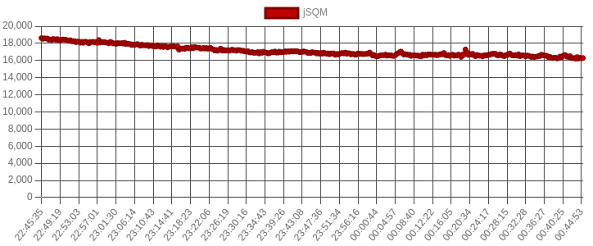
| Indi Allsky backyard camera measurements from 11/17-18/2025 including pseudo sky quality and star count metrics suggesting reasonably fair skies with no clouds overnight. |
In a final insult to injury, plate alignment initially failed to complete at some point before guiding and capturing began... and so the 12x80s light frames that were captured were badly offset from the target. But nevertheless, the experience did resurrect the Orion Short Tube 80 OTA with the Xyzyl 8-position filter wheel and the settings required for future use. Additional work is still needed to adjust back focus with different spacers to attempt to correct for remaining coma at the extreme edges of the frame.


Comments
Post a Comment